
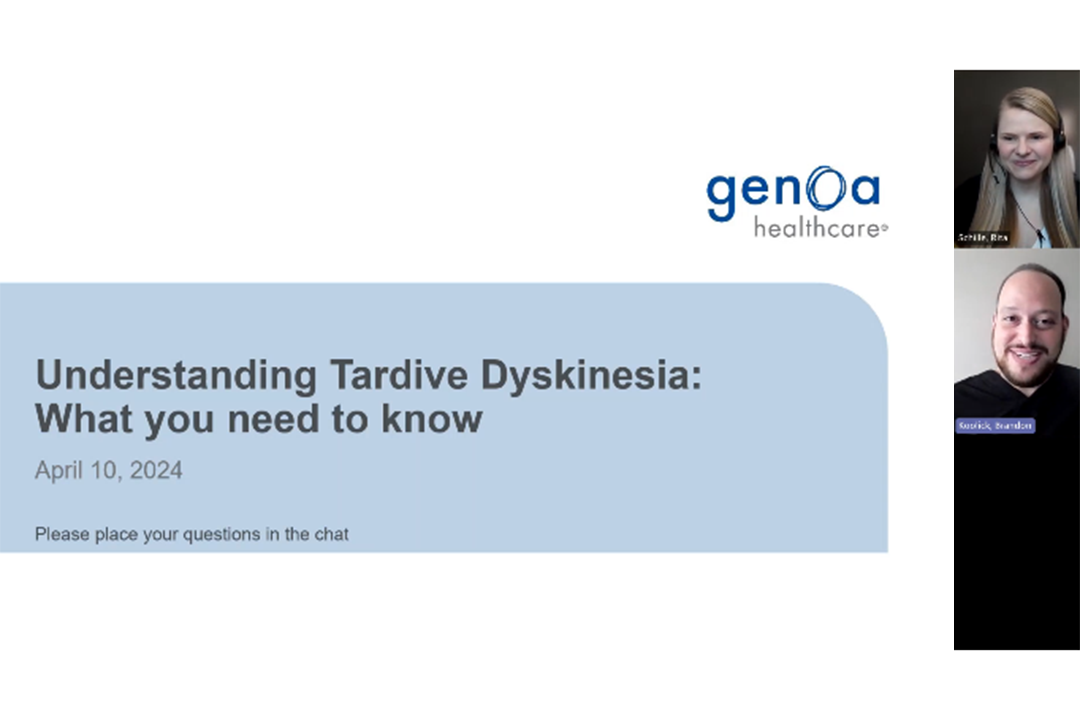
Understanding Tardive Dyskinesia: What you need to know
April 11, 2024


Tardive Dyskinesia (TD) – a neurological disorder associated with prolonged use of antipsychotic medications – affects over 600,000 people annually.
Wondering what this means for the people you serve?
Genoa Healthcare recently hosted a webinar to discuss risk factors associated with TD, diagnostic criteria and assessment of TD, and approaches to managing and mitigating the symptoms. The webinar also covered costs and clinical outcomes of treatment options for consumers living with TD.
Watch the recording here:
00:00:00
Right.
00:00:00
Welcome to our webinar, Understanding Tardive Dyskinesia, What You Need to Know.
00:00:06
I'm Brandon Kulik and I'm a pharmacist and site manager for Genoa number 10740 in Metro Phoenix.
00:00:12
And I'm proud to be co-presenting with my partner here, Rita Shelley, Pharmaceutical Program Manager.
00:00:19
It's our pleasure to be here presenting with you all today and we really appreciate your attendance and your attention.
00:00:24
This is a subject that Rita and I are very passionate about.
00:00:27
It's one that we encounter every day in practice, and it's one that's very important near and dear to us.
00:00:34
Because by recognizing symptoms and raising awareness and having these impactful conversations, we can ensure that our patients are able to receive appropriate treatment and lead fulfilling lives without compromising their antipsychotic therapy.
00:00:48
The goals of today's webinar are to familiarize everyone with tardive dyskinesia.
00:00:54
So, to do that, we must begin our discussion by differentiating between acute EPS, or extrapyramidal symptoms, and tardive dyskinesia.
00:01:03
We'll highlight patients who are most at risk by discussing their characteristics, we'll identify signs and symptoms, and finally, we'll review the management and treatment options currently available.
00:01:14
Also, Rita will have a brief overview of Genoa's Clinical Assistance Program, which helps monitor adherence in patients with tardive dyskinesia, or TD, leading to more positive patient outcomes.
00:01:26
Before we really jump into the webinar, I wanted to start out with a patient's story, and this is something that really highlights the importance of identifying TD, treating it appropriately, and working with the pharmacy team.
00:01:39
JW is a 56-year-old male.
00:01:41
He suffers from schizoaffective disorder.
00:01:43
He's independent, however, he presented to the clinic and the pharmacy as a new member, having recently been initiated on benztropine by an outside clinician.
00:01:53
He stated that his symptoms progressively worsened after initiation of this new medication, and his movements were so bad that he required the use of a water and avoided social situations where he felt uncomfortable.
00:02:06
Now, unfortunately to him, these were almost all situations.
00:02:11
Benstropine was slowly discontinued, and a VMAT2 inhibitor was initiated, and the members started to see some resolution of his involuntary movements within about 3 weeks.
00:02:21
Now, at two months follow-up, he presented to the pharmacy completely in tears.
00:02:26
I vividly remember him saying something to the effect of, I'm not stuck anymore, and the joy on his face when he was able to tell the staff that he used the stairs
00:02:36
not the elevator to get to our second-floor pharmacy, was enough to make anyone a believer in these medications.
00:02:43
He didn't feel like he needed to be confined to his home for fear of falls and potential embarrassment.
00:02:49
This was truly incredible and something I wanted to start to showcase what we're all capable of achieving as members of the medical team.
00:02:58
Antipsychotic movement disorders.
00:03:00
Now, this is a very broad term, and it encompasses many different clinical conditions.
00:03:05
But we need to be able to distinguish between them because the treatment options will vary and misidentification, it actually can lead to improper selection of pharmaceutical agents.
00:03:15
And this can potentially worsen our patients' conditions.
00:03:18
The good news is, over the years, the incidence and the risk of movement disorders have decreased with an increased reliance on newer generation antipsychotics.
00:03:30
However, despite this welcoming fact, movement disorders still play a very important role in our clinical practice.
00:03:35
So we all need to be able to recognize these symptoms in order to best help our patients.
00:03:42
I'd like for everyone to think of acute extrapyramidal symptoms as a big umbrella term.
00:03:48
And under that umbrella, we have different types of movement disorders.
00:03:52
First, we have akathisia.
00:03:53
Now, this is very common and something that typically happens very early on in therapy.
00:03:58
And this can be described as an inner restlessness or urge to move.
00:04:02
I've had patients describe this to me as being like the Energizer bunny.
00:04:05
You know, they're wound up, they can't control it, it's very uncomfortable.
00:04:09
These movements particularly occur within two to three weeks of starting an antipsychotic drug, and about 50% of them occur within the first month.
00:04:20
Now, this is a little different from drug-induced Parkinsonism, or DIP.
00:04:23
This can be described as hypokinetic.
00:04:26
The more common signs of drug-induced Parkinsonism are tremors, movements that appear very slow, very stiff.
00:04:33
You can almost time them to a metronome.
00:04:37
And last, and unfortunately most serious, we have acute dystonic reactions.
00:04:42
Now, these are easily distinguishable because not only are they uncomfortable, but they can be very painful for patients, and these are life-threatening.
00:04:49
They're considered hyperkinetic, and they usually occur within one to four days of initiation or dose change of medication.
00:04:57
And these are the medical emergencies, and these need to be treated with IM and IV medications.
00:05:03
So very, very important to notice the difference.
00:05:08
We have different treatment options based on what type of movement disorder our patients are experiencing.
00:05:15
Now, the preferred evidence-based treatment, which is the gold standard for all of medicine, evidence-based, to start with akathisia, is a centrally acting beta blocker.
00:05:26
This is propranolol.
00:05:27
We've all heard of propranolol.
00:05:29
It's used, its use has the most evidence in akathisia, but it's important to take the whole patient into account.
00:05:37
We do need to be concerned with things like hypotension and bradycardia.
00:05:42
We can also use benzodiazepines as an alternative in the short term, but benzodiazepine should really be used at the lowest effective dose for the shortest time frame possible.
00:05:52
There continues to be new studies published all the time detailing the risk of early onset Alzheimer's with long term use of these agents.
00:06:01
So if propranolol isn't an option, mirtazapine could also be a good long term treatment option.
00:06:08
I do want to stress Benstropine, or the trade name Cogentin, which I'm sure we've all heard of, is not recommended for the treatment of akathisia.
00:06:16
In fact, the current guidelines, APA, the American Psychiatric Association, states that akathisia tends not to respond to anticholinergic treatment unless akathisia is present alongside drug-induced Parkinsonism.
00:06:32
And this is where Benstropine
00:06:34
Orcogentin is actually preferred for treatment.
00:06:36
We do want to use anticholinergics in drug-induced Parkinsonism.
00:06:41
However, anticholinergics do have a very difficult side effect profile to manage.
00:06:46
And in pharmacy school, and Rita, I'm sure you can attest to this, we learned that patients on anticholinergics tend to be mad as a hatter, which describes delirium, red as a fox, dry as a bone, they have dry mouth, dry skin, blind as a bat because it affects vision,
00:07:03
I know these are crude, but these are ways that we remember the side effects of these medications.
00:07:08
They can be pretty bad.
00:07:10
Amantadine is a suitable alternative in that case.
00:07:13
But for acute dystonic reactions, these life-threatening, these are medications that we need to treat rapidly with intramuscular and intravenous medication.
00:07:22
Some risk factors, though, for these acute dystonic reactions include being young in age of the male sex, history of cocaine use,
00:07:33
and acute dystonic reactions prior.
00:07:35
So it's very important to reevaluate patients' antipsychotic regimens after an initial episode of an acute dystonic reaction and any subsequent episodes thereafter.
00:07:49
So now that we've discussed what TD isn't, let's talk about what it is and why it's important and why we should be aware of this.
00:07:57
Currently, there's about 600,000 people in the United States living with tardive dyskinesia, and it's estimated that approximately 65% of those have not been diagnosed yet.
00:08:08
The incidence and the risk with the use of second-generation antipsychotics might be lower overall.
00:08:15
However, exposure has increased.
00:08:18
because the use of these second-generation antipsychotics have expanded to more indications, and the drugs are being started earlier on in life.
00:08:28
So patients with mood disorders receiving second-generation agents, very commonly we use them as adjunct, they're being exposed earlier on in life, and they therefore develop a risk of developing TD in the future.
00:08:43
Like we discussed earlier, TD is considered to be a subset of EPS.
00:08:48
However, unlike EPS, tardive means late, so we're not going to see these symptoms present for months or years after antipsychotic exposure.
00:08:58
And even if we reduce the dose or discontinue the medication altogether, symptoms still may persist and may even increase.
00:09:06
So it's important to note that the risk of TD increases based on cumulative exposure to antipsychotic or dopamine blocking agents.
00:09:16
And one of the reasons so many of these individuals have yet to be diagnosed is that TD can be hard to distinguish, it can be hard to see.
00:09:25
The movements can be subtle, they can be fluctuating, and they typically involve the mouth and the tongue, but they can also frequently, and also do frequently involve other parts of the face, the arms, the legs, the torso, and let's not forget the diaphragm, that's a muscle too, we can see issues with breathing, speech impediment,
00:09:45
A ton of different body systems can be affected by this.
00:09:51
There are a number of factors that impact an individual's risk of tardive dyskinesia.
00:09:55
And while younger patients are still at risk of TD, older age is a major risk factor.
00:10:02
Other patient-specific risk factors include being of the female gender, one's race, and comorbidities.
00:10:09
Now, these comorbidities include things like mood disorders, a prior history of extrapyramidal symptoms,
00:10:15
cognitive impairment, substance abuse, diabetes, and even smoking.
00:10:20
Do these risk factors sound familiar?
00:10:23
Unfortunately, these comorbid conditions are very common in our patient population, so it's important we look at our patients as a whole, not just the fact that they're on these antipsychotic or dopamine blockade agents.
00:10:37
Treatment-specific risk factors, like cumulative exposure to antipsychotics,
00:10:42
And other agents like metoclopramide also are treatment-specific, but also exposure to high doses of these medications also put a patient at higher risk.
00:10:54
And the fact that a patient had an antipsychotic five years ago can't be ignored.
00:10:59
In fact, first-generation antipsychotics specifically, there's an increased incidence of TD.
00:11:05
We approach about a 50% chance of a patient on a first-generation.
00:11:10
developing tardive dyskinesia by 10 years of continuous use.
00:11:15
And how long do we treat these mental illnesses for?
00:11:17
They're lifelong.
00:11:19
Our patients are going to be on these medications, presumably for life.
00:11:24
I keep talking about these different first generation, second generation.
00:11:28
They all have the potential to cause tardive dyskinesia, but the highest risk is amongst the first generation, like Haldol, Chlorpromazine, and Flufenazine.
00:11:38
But metoclopramide also carries a relatively high risk, and we can't ignore that.
00:11:42
It's an agent we typically don't see very commonly in behavioral health, but it's something we do need to keep top of mind.
00:11:50
Now, of the second generation antipsychotics, risperidone appears to have the highest relative risk, with paliperidone the next highest relative risk.
00:11:58
And this makes sense because paliperidone is an active metabolite, so we would associate the two as both being very high in risk.
00:12:06
And while it's still possible with other second-generation antipsychotics, it appears to be quite low, if not absent, for quetiapine and clozapine.
00:12:15
And it makes sense why are all of our patients, so many of them, are on these medications.
00:12:22
The American Psychiatric Association, or the APA, recommends clinical assessment for tardive dyspinesia at each visit for patients on antipsychotic drugs.
00:12:33
Routine screening is important so that we may recognize these symptoms early because potential discontinuation of whatever drug is causing it may offer the best chance at symptom recovery.
00:12:45
But because we know these medications are going to be used long term, unfortunately, discontinuation is not always the best option.
00:12:52
So we want to monitor at baseline.
00:12:54
And every six months, if a patient's at a higher risk agent like a first generation, such as Haldol,
00:13:00
or every 12 months for a second generation for drugs like Abilify.
00:13:05
High-risk patients, however, should be monitored more frequently.
00:13:08
This is every three to six months.
00:13:10
But myself and my colleagues are all very much under the impression that we should be looking at our patients every chance we get, and not just the clinicians or the providers.
00:13:21
In fact, why not?
00:13:22
Let's train our staff, let's the front office staff to look for symptoms of movement disorders.
00:13:27
I mean, I think this is a great idea.
00:13:29
The front office staff and even your pharmacy team, we have a lot of interaction with our patients and frequently have the opportunity to observe them in a non-clinical setting where they're a little bit more relaxed.
00:13:42
You know, they're not in front of the provider, they're not being directly observed, they're a little bit more disarmed.
00:13:47
So it's, we're a great resource to help be able to distinguish are there movements present.
00:13:54
We discussed a little bit about, you know,
00:13:57
what tardive dyskinesia is.
00:13:59
But the question is, how do we diagnose it, and how do we assess the severity?
00:14:04
Well, we diagnose based on the DSM-5, but what's important is to assess the severity.
00:14:09
We use something called the AIMS.
00:14:11
Now, this is the Abnormal Involuntary Movement Scale, and this measures severity.
00:14:16
It's the subject's awareness and incapacitation due to movements.
00:14:20
I do want to point out one very important fact, though.
00:14:23
that AIMS is not diagnostic.
00:14:27
It is simply the severity of the movements.
00:14:31
We can't wait until our patients are so severe that they can't leave the house or perform regular activities of daily living, like showering and dressing.
00:14:41
The AIMS is a clinician rating scale, and it looks at 12 different items scored from zero, or no movements, to four, which are severe movements.
00:14:52
Now, a positive AIMS examination is a score of two in two or more movements, or a score of three or four in a single movement.
00:15:01
We do want to pay close attention to facial and oral movements.
00:15:05
We really should be roping in our dental colleagues to assess for oral lesions and denture misfitments.
00:15:12
But we also want to look at extremities, the hands, the feet, and the chest movements as well.
00:15:19
We use something called a contralateral activation maneuver.
00:15:23
And this is something that can substantially bring out movements to the forefront.
00:15:27
Now, this is when we have our patients touch their fingers to their thumb.
00:15:32
And while we're doing this, we're not observing this movement.
00:15:35
What we're actually doing is observing the contralateral side of their body, and we're looking for their hands and their feet at rest, what they're doing.
00:15:45
We can also do something called serial sevens.
00:15:47
Now, this is where we ask our patients to count from 100 and then subtract 7 each time.
00:15:52
Now, I don't know about all of you, but I'm not particularly great at that.
00:15:57
However, it's not the math we're concerned about.
00:15:59
What we are concerned about is keeping them cognitively entertained while we monitor other parts of their body.
00:16:06
This tends to bring those movements to the forefront, and we can truly assess how severe they are.
00:16:13
TD can have significant effects on a patient's quality of life.
00:16:17
We know that.
00:16:18
And although the impact does appear to be influenced by the severity of the tardive dyskinesia, even those with mild symptoms can have negative effects on their quality of life.
00:16:29
So preventing TD is really of primary importance, and best practices should be followed to help minimize the risk.
00:16:37
As we mentioned earlier, routine screening is important.
00:16:40
We need that to be able to recognize these as soon as possible, but also limit prescribing of the antipsychotics to clinically appropriate indications.
00:16:49
We want to use the minimum effective doses required, and we want to reduce duration of therapy, if at all possible.
00:16:57
The one thing I do really want to stress is with anticholinergics.
00:17:01
These medications, Benstropine, trade name Cogentin, they may actually worsen
00:17:07
Oral and facial dyskinesias they impair cognition and physical function.
00:17:12
They are not appropriate treatments for targetive dyskinesia, and we do our patients a disservice and can potentially cause harm.
00:17:20
So, now that we know what TD is and what it isn't.
00:17:25
what we look for and how we assess it, let's get to the good stuff.
00:17:28
I'm gonna turn this over now to Rita, and she's going to go through and discuss how we effectively treat tardive dyskinesia and how we can improve our patient's quality of life.
00:17:37
To you, Rita, thank you.
00:17:40
Thank you, Brandon.
00:17:42
Like Brandon said, my name is Rita Schilley.
00:17:44
I'm a pharmaceutical program manager for Genoa, and I manage a clinical assistance program for patients newly starting on TD treatments, as we will discuss a little bit later in the webinar.
00:17:54
Prior to this role, I was also a lead clinical pharmacist on one of these programs, and I also have been a generalist site manager as well.
00:18:02
I'm really happy to be here to discuss this very important topic.
00:18:05
And like Brandon said, I get to discuss the good stuff, so the treatment options.
00:18:11
So the exact mechanism of tardive dyskinesia is really not fully understood.
00:18:16
However, it's generally believed to be a result of long-term blockade of dopamine D2 receptors in the nigrosteroidal pathway.
00:18:26
To address this concern in an indirect way, the development of VMAT2 inhibitors were released on the market.
00:18:34
These medications actually reduce the amount of dopamine that's released into the synapse, thus reducing the overstimulation of dopamine receptors that theoretically causes those hyperdyskinetic movements of TD.
00:18:50
Preferred treatment options include valbenazine and do tetrabenazine, but all three of these options, including tetrabenazine, are used in the US.
00:19:00
For patients with persistent, bothersome TD, VMAT2 inhibitors are the primary drug therapy.
00:19:08
In 2020, the APA, American Psychiatric Association, released updated guidelines which recommends VMAT2 inhibitors for patients who have moderate to severe or disabling TD associated with antipsychotic therapy.
00:19:24
These medications can be used with patients with mild symptoms too.
00:19:28
As Brandon mentioned, this impairment and effect on psychosocial functioning can even impact those with mild symptoms of TD.
00:19:37
All three of these are used in the U.S., however, we prefer those newer options, the valbenazine, do tetrabenazine, that go by the trade names Ingreza and Ostedo, due to their longer half-life, which increases convenience for the patient, and the more desirable side effect profiles compared to tetrabenazine.
00:19:58
A reduction in AIM scores has been observed with both of the preferred treatment options in as early as two weeks of therapy, but really we typically see benefit in two to six weeks of therapy.
00:20:09
All right, so now I'm going to go into a little bit more detail into our two most commonly prescribed medications for tardive dyskinesia.
00:20:19
We'll start with Dutetrabenacine or Osteto.
00:20:23
The twice-daily formulation of AUSTETO was released to the market in 2017, and more recently, Teva has released the extended-release XR formulation in 2023.
00:20:36
I've listed the common titration schedule on the right side of your screen here to show that titration of AUSTETO is very important to get the patient to an effective dose.
00:20:46
Typically, we can increase the dose by 6 milligrams per day per week until we achieve efficacy as tolerated by the patient.
00:20:56
There is an available four-week titration pack available that ends with week four or 30 milligrams per day.
00:21:04
This is something to keep in mind when sending a continuation order to the pharmacy that the next recommended dose in the titration schedule would be 36 milligrams per day.
00:21:16
Average dose in clinical trials was over 36 milligrams per day for patients.
00:21:22
And that means many of our patients are going to require higher doses to get the most benefit for their TD movements.
00:21:29
Of note, maximum dosing is 48 milligrams per day for austedo.
00:21:35
The twice daily formulation or that immediate release formulation does require food for best administration and absorption, but the XR formulation does not require food for that absorption.
00:21:47
This is something to keep in mind in those patients who don't have a routine eating schedule or may not have a routine schedule that they can take a twice daily dosing consistently.
00:22:00
We really want to get our patients to effective doses efficiently in a timely manner to prevent patients from being discouraged and discontinuing this medication prior to efficacy being achieved.
00:22:13
We can see common side effects as far as nasopharyngitis or that swelling of the nose and throat, as well as some difficulty sleeping, both in 4% of patients.
00:22:25
All right.
00:22:26
Go to the next slide and we'll discuss a little bit more about Ingreza or Valbenazine.
00:22:34
Ingreza was also came to the market in 2017 as a once daily dosing option and preferred treatment option for TD.
00:22:46
Target dose for Ingreza is 80 milligrams per day and is available as 40, 60 and 80 milligram capsules.
00:22:55
There's also a titration kit available for Ingreza, which includes one week at 40 milligrams a day and the weeks two through four are 80 milligrams per day.
00:23:06
Keep in mind there is a 60 milligram dosing option now available for those who might not tolerate the 80 milligram preferred dose or for those patients with drug interactions that may make the higher dosing inappropriate.
00:23:21
Evening administration is preferred with Ingreza for most patients, especially with the most common side effect being sedation, especially when patients are first starting the medication.
00:23:32
Food administration is not required, so they can easily take it at bedtime without the fear for loss of efficacy with not taking with food.
00:23:42
We do want to keep in mind that there are some anticholinergic side effects associated with Ingreza, so this may be something to monitor for patients, especially in the elderly population, as Brandon already went over the risk with these medications.
00:23:57
All right, so now we're going to go into some second-line treatment options.
00:24:01
Benzodiazepines, like clonazepam, have been used for TD, but really the evidence of benefit is limited and inconclusive with treatment for TD with these meds.
00:24:12
sometimes potentially effective for mild symptoms, but is unlikely to help for more severe TD.
00:24:19
Really being a scheduled medication with physical, psychological dependencies limits its usefulness in long-term therapy.
00:24:27
So something to keep in mind there.
00:24:29
And then there are some other options that have insufficient evidence to warrant their use, including amantadine, ginkgo biloba, vitamin
00:24:40
E, vitamin B6, beta blockers, calcium channel blockers, serotonin antagonists, GABA agonists, valproate, levotriacetam, buspirone, and lithium.
00:24:52
And for those patients that really are unresponsive, are not responsive to any pharmacological treatment options, you could consider a referral to a multidisciplinary movement disorder clinic for consideration of deep brain stimulation.
00:25:07
All right.
00:25:08
Then we wanted to go over some medications that are not effective for TD, and Brandon mentioned this a little bit before, but those anticholinergic medications.
00:25:18
While these are appropriate for things like acute dystonia as well as drug-induced Parkinsonism, really the use for TD is typically not recommended.
00:25:30
They're usually ineffective and may exacerbate those choreiform dyskinesias, which are more of those rapid, jerky, and non-repetitive
00:25:38
movements of TD.
00:25:40
Sometimes may be helpful for a different type of movement concerned the tardive dystonia, but typically with long-term use has been associated with increased risk for TD and can worsen those movements as well.
00:25:55
And then also the botulinum toxin, typically not effective for TD, but might be potentially beneficial for tardive dystonia.
00:26:05
So if you have a patient that their biggest concern with movements is their tardive dyskinesia, and you're wanting to discontinue their anticholinergic medication, for those patients who have been on benztropine or other anticholinergic agents long-term, and especially at higher doses, we really recommend tapering the patient off their anticholinergic therapy to help prevent sudden return of movements or potential withdrawal symptoms like nausea, sweating, agitation, restlessness,
00:26:35
insomnia, to name a few.
00:26:37
We don't want patients who are starting a new therapy, but at sub therapeutic doses to associate these symptoms with their new medication and not want to continue.
00:26:48
All right, so now I want to go into a little bit more about those clinical assistance programs that I help manage.
00:27:01
With both of these medications, we tend to see an early drop off in the first few months of therapy.
00:27:07
Back in 2019, Genoa developed the first clinical assistance program to offer ongoing pharmacist support for patients newly starting tardive dyskinesia medications.
00:27:21
They get access to a specially trained clinical pharmacist that provides ongoing support throughout their first full year of therapy to help reduce this drop-off and help them achieve efficacy with these medications.
00:27:35
During the first encounter, the pharmacist goes through extensive medication counseling around when to expect efficacy, drug-to-drug interactions that might impact side effects or efficacy,
00:27:49
They go through adherence concerns such as the cost or coverage of the medication that may impact their adherence.
00:27:56
And they also set up a realistic expectation of when we will be reaching out to the patient throughout therapy.
00:28:04
During that first month, when drop off is high, our pharmacists are touching base with our patients on a weekly basis to really help address tolerance of the medication, are there side effects that they're experiencing that are expected and transient
00:28:19
and will improve with time as they continue therapy?
00:28:23
Are they having issues remembering to take a twice a day or once a daily medication and adding that to their regimen?
00:28:30
Or are they just not achieving efficacy as soon as they expected and wanting to stop the medication?
00:28:38
Education, adherence education is so important for the continuation of these medications, and our pharmacists at Genoa Clinical Services really attempt to specialize this to each individual patient.
00:28:50
What are the barriers that specifically impact each patient's care with their tardive dyskinesia medication?
00:28:59
Our pharmacists also coordinate care with the pharmacy and prescribing team when appropriate.
00:29:06
Great.
00:29:06
So on the next slide, go ahead.
00:29:09
I'm sorry, Brandon.
00:29:11
Rita, I'm so sorry to interrupt you.
00:29:13
We have a couple of really great questions in the chat specifically regarding the Clinical Assistance Program.
00:29:20
I think you're still going to get to a couple of them, but one I want to just make sure you can touch base on.
00:29:25
There's a really great question about, are there any affordable VMAT2 inhibitors?
00:29:30
Do we know when they'll be released more generic production to get the cost down?
00:29:36
it tends to be there's a sense of obtaining the medication as being difficult because of cost.
00:29:42
Nope, and we completely understand the cost barriers for patients.
00:29:46
Like I said, both of these medications weren't released that long ago, the newer agents in 2017 for both of those.
00:29:54
So the generic availability probably is still a ways down the road.
00:29:58
We do have several programs available to help patients afford these medications.
00:30:05
Especially for patients in the clinical assistance program, our clinical pharmacists can help direct the patient towards programs they may qualify for, or our site pharmacists are familiar with these programs as well.
00:30:17
Our general sites do a great job at starting that PA process and following up on that.
00:30:22
And there's also programs available both by the manufacturer and specific grant programs available to help patients to be able to afford these medications.
00:30:34
For patients with Medicare insurance, there's grants through the HealthWell program that offers grants to patients being treated for certain disease states, including tardive dyskinesia.
00:30:46
There's also copay cards available for your commercial pain patients and some free trial vouchers to help get the patient started on their first 30 days of medication prior to that PA being approved.
00:30:59
So there's definitely some options and Jenna's psych could also be able to provide some more information on getting a patient set up with these assistance programs as well, if they're not choosing to be part of the clinical assistance program.
00:31:15
Perfect.
00:31:15
Thank you, Rita.
00:31:16
One other question that I think you're going to be getting to as well.
00:31:20
Is the clinical assistance program available through all Genoa pharmacies?
00:31:25
That's a great question.
00:31:26
And yes, it's available to all patients newly starting on these medications.
00:31:31
They have to be within their first 30 days of therapy because we really want to catch them at the part of therapy where we see highest drop off.
00:31:39
So we want to provide that extended care throughout their first year of therapy.
00:31:43
But if you do have a certain patient that you want to help get connected with these clinical assistance programs, you can definitely reach out to the site manager at your clinic pharmacy and they'll help you get more
00:31:55
information or get you connected with the programs.
00:32:00
Perfect.
00:32:01
And then one more that just came in.
00:32:03
Great question.
00:32:04
How do patients enroll and does it cost them anything to participate?
00:32:07
And if you don't mind, Rita, I'd like to take the first part of this.
00:32:11
That's fine.
00:32:12
Yeah, so patients enroll as a site manager, when we get a new prescription for one of these medications, we have a series of steps built in to make sure that each and every time that there's a new prescription, we're able to try and identify these patients, and we're able to have these conversations with them and enroll them at the site level.
00:32:33
And then if you could elaborate and take the rest of that, Rita.
00:32:38
Yeah, definitely.
00:32:39
It doesn't cost, these are free programs to the patient, so it doesn't cost them.
00:32:44
We really don't want that to be a barrier for these programs.
00:32:48
And I know our site, Genoa Pharmacists, do a great job of doing that initial counseling with a patient and even doing follow-up too.
00:32:56
But this provides them a pharmacist that's giving them their full undivided attention during these clinical assessments and really diving deep into how the patient's doing and getting the most from their drug therapy.
00:33:08
Perfect.
00:33:09
Thanks so much, Rita.
00:33:11
Sounds good.
00:33:12
So in addition to the educational and counseling pieces that we discussed before, if there is a drug therapy problem identified or a barrier to care that the clinical pharmacist identifies, they coordinate directly with the onsite Genoa pharmacist and the prescribing team to really help ensure that the medication itself is being optimized.
00:33:36
So listed here are some of the examples of identified barriers that really impact tardive dyskinesia medication optimization.
00:33:44
And then I am gonna provide one patient impact story as well that gives another barrier to care.
00:33:50
So drug interactions, that's one thing that we do during our first encounters is going through that entire med list and checking in on any medication changes that really might impact how they're tolerating or getting the effect from their TD medications.
00:34:06
So meds that reduce efficacy, they may need a higher dose.
00:34:10
Drug interactions that increase risk for side effects, they may need a lower dose to help reduce that risk.
00:34:16
And then recommending titration schedules when not followed.
00:34:19
So some patients get started on very low doses of the medication without titration plan, and they may get frustrated that they're, you know, it's been two, six weeks, I'm not seeing any change, and you told me I'm gonna start seeing a change after this time, properly titrating and get,
00:34:35
getting them to an efficient dose, an effective dose in a quick manner while tolerating is very important for these meds.
00:34:45
And then side effects due to improper administration.
00:34:48
So adherence concerns come into part here.
00:34:50
So if a patient's missing their dose or forgetting their dose for four days and they go back on the same dose, they may experience more likelihood of experiencing side effects at that time, or they're sleeping until noon every day and they think it's too soon
00:35:05
to take or it's too close together with their bedtime dose to take their morning dose or they take them both together.
00:35:12
There's just so many different things that can be identified and corrected quickly with these with this ongoing support and then just reduced efficacy due to improper administration like we talked about with AUSTEDO, DID requiring food.
00:35:26
If they're not able to take it with food, maybe it's a discussion about whether the XR formulation is more appropriate for the patient or if they can change their eating schedule to
00:35:35
at least get some food in their body while they're taking the medication.
00:35:39
Now, we've seen with these clinical programs, we've seen an improvement in time on therapy for these medications, and we see an improvement in persistence.
00:35:50
And really by controlling their TD with these medications, we're not just controlling their TD, but patients are really less likely to stop their antipsychotic meds, which are causing these movements, which helps prevent hospitalizations.
00:36:04
And studies show that
00:36:05
each behavioral health hospital stay reduces life expectancy.
00:36:10
By improving time on therapy and reducing discontinuations early, these programs can help improve quality of life and improve or maintain life expectancy for patients living with TD and complex behavioral health concerns.
00:36:24
So like I said, if you're interested in these programs or interested in getting one of your patients on one of these programs, definitely reach out to your site manager at your site for more information.
00:36:35
All right.
00:36:35
So then I'm going to go over one patient impact story regarding a patient who we did enroll in the clinical assistance program with Genoa.
00:36:47
So this patient was a 57 year old female.
00:36:51
She was cared for by her mother and caregiver and she had a history of two separate car accidents.
00:36:58
She was hit by two separate drunk drivers resulting in disability.
00:37:03
Her disability really impacted her mental health, her mother said.
00:37:08
And prior to being diagnosed with heart of dyskinesia, she had a hospital stay where 14 of her medicines were discontinued, including long-term use of Haldol.
00:37:20
So we already know the patient has long-term history with a first-generation antipsychotic.
00:37:25
Her mother reported that the TD movements were really impacting her life, especially these thrusting jaw movements that were basically constant for the patient.
00:37:34
She also had some shaking in her hands as well, but the jaw movements were really something that was a barrier for her.
00:37:42
She required gum and hard candies to control the movements when, if not doing sugar free, she was also had diabetes, so could impact that disease state as well.
00:37:53
Her psychiatrist prescribed one of the new VMAT2 inhibitors, and the generalist site sent this out to the patient, so she had it in hand when we first contacted the patient and her mother.
00:38:06
When our pharmacist first had the conversation with with the caregiver and with the patient, the mother confided in our pharmacist that she had done her own research.
00:38:17
She'd gone online, read about side effects, and even though this medication had been dispensed to her, she just wasn't going to give it to her daughter.
00:38:24
She didn't think she wanted to add more side effect concerns for her daughter at this time.
00:38:30
Our pharmacist at Genoa Clinical Services went over the common side effects, how titration schedules can reduce the risk for side effects, and also went over that we'd be checking in on a weekly basis during that first month to ensure she was tolerating the therapy.
00:38:47
She was also able to discuss how we've seen firsthand how these medications can really impact a patient's quality of life.
00:38:55
After that conversation with the pharmacist, the mother decided during the call that she was going to give the patient her first dose.
00:39:03
On the first follow-up encounter, the mother was already noticing some improvement in the jaw thrusting movements.
00:39:10
Now, we know it typically takes at least two weeks, but they had reported that they are starting to see some change, and she wasn't needing the gum or hard candies constantly to control the movements.
00:39:22
The pharmacist and the caregiver had a discussion about the dosing as she was actually prescribed lower than recommended starting dose of this medication.
00:39:31
To help her achieve efficacy, they had the conversation about sending a recommendation to her Genoa site so the site pharmacist could have a conversation with the prescriber about potentially increasing the dose prior to her next follow-up.
00:39:45
This was approved and the patient was able to start that new dose efficiently before she even was able to see her psychiatrist for her next visit.
00:39:54
Now, I know we don't have the full story available yet for this patient, as she's still part of our clinical assistance program, but this just illustrates a couple of barriers that we see as part of this program.
00:40:06
Starting that medication and taking that initial dose can be a barrier for patients that our pharmacists work to overcome.
00:40:14
And secondly, titration schedules that aren't followed, even though they might get initial improvement, may not get them to a point where they're satisfied with their control of their TD movements.
00:40:26
So increasing and titrating efficiently, especially when well tolerated, is an important step of therapy.
00:40:34
Now I'm going to hand it back to Brandon, who is gonna go over something that he's done at his clinic to help those patients newly starting on these TD regimens.
00:40:46
Thank you.
00:40:48
Thanks so much, Rita.
00:40:50
Thank you for answering those questions as they came in.
00:40:53
You know, we've got some really great questions in the chat, and something that I actually really appreciate is the fact that most of these questions appear to be
00:41:03
cost-based questions, which I'm actually really happy to hear about because that means we're identifying tardive dyskinesia and these medications are being written for and they're actually being filled.
00:41:15
But another good one that came in, it states that it can be frustrating when a client starts on a medication with a free trial, but then it becomes cost prohibitive.
00:41:24
And I get that.
00:41:24
I've definitely heard that echoed many times.
00:41:28
What we're going to do afterwards is send out some resources that will contain some information about applying for grants, about different programs that are economic based for the patients.
00:41:40
And the patient story that I shared earlier, that individual was actually a recipient of a grant because it was cost prohibitive for him.
00:41:50
And in this individual, it's really what made a difference.
00:41:54
So if there's an economic need,
00:41:57
There are a ton of resources available.
00:41:59
And like I said, more of those will definitely be coming following this webinar.
00:42:04
But just to kind of wrap up, what we can do at Genoa, partner with your pharmacy, please.
00:42:10
That's why we're there.
00:42:12
As a site manager, I want to do everything I can to help my providers, my nurses, ultimately in our collective quest to help our patients.
00:42:21
And in order to do that, because titration schedules can be a little bit confusing, partner with your pharmacist.
00:42:27
Go ask them to make sure you all understand.
00:42:30
Make sure that the patient understands we're truly here to help.
00:42:34
Additionally, we know, again, based on cost, prior authorizations do present issues, but your general pharmacy is well equipped to handle and help address those prior authorization concerns as well.
00:42:49
We really, really appreciate all of your time and attention.
00:42:52
What we're going to do now is take some time for some additional questions that didn't appear earlier on.
00:42:59
And let's go back and take a look.
00:43:04
OK, so Rita, let's take this question.
00:43:07
Are you aware of any fiscal support for clients on antipsychotics with TD who are in the jails?
00:43:14
And I'll start with this one, so I'll be honest.
00:43:17
Once a member is in jail, their Medicaid support, to the best of my knowledge, is no longer effective.
00:43:26
So the cost and the payment for those medications fall on another support system.
00:43:32
And I'll go ahead and I'll follow up later with additional details.
00:43:36
That is a rather tricky situation.
00:43:39
And there are
00:43:41
There are a few solutions.
00:43:43
I would have to get some more information on that for you.
00:43:46
Rita, do you have any additional details to add about that?
00:43:49
No, I think I would have to look into more details as well, Brandon, but we can definitely follow up with you, Shawna, too, regarding the question.
00:43:57
Absolutely.
00:43:58
That's a great one.
00:43:59
And it's one that has come up often.
00:44:01
And what we do see is in the situations where this has been presented in the past, you know, I can't think of any situation where a patient has received that medication when they were incarcerated.
00:44:14
So that is something that we'll definitely look into.
00:44:20
Any other questions from anybody?
00:44:32
All right.
00:44:33
If anybody does think of anything, please don't hesitate.
00:44:36
We'll have, like I said, additional time and resources dedicated to answering anything that may come up.
00:44:43
Oh, we did get one.
00:44:44
Let's see here.
00:44:46
Oh, what will be a good approach to a provider that have been prescribing benztropine for tardive dyskinesia?
00:44:53
This is actually a really, a really great question.
00:44:56
And I think a lot of it depends on the provider that is writing for the prescription.
00:45:00
And I can tell you from my perspective, it's really great to be able to go and address it casually, discussing that, you know, current evidence-based treatment may not support the use of benztropine in this particular disease state.
00:45:15
It does still happen.
00:45:16
There are still providers that may not be most up to date with the current information.
00:45:21
They also may be still prescribing benztropine for comorbid conditions.
00:45:27
So it is possible to have tardive dyskinesia along with drug induced Parkinsonism.
00:45:33
Now these are very unique cases where an anticholinergic is warranted.
00:45:39
However, we do know that it can worsen the tardive dyskinesia while temporarily taking care of the drug-induced Parkinsonism.
00:45:46
So a good approach, I think, in my opinion, would be to first get some more information from the provider.
00:45:53
you know, respectfully ask, you know, out of curiosity, do we have another disease state we're using this particular medication for?
00:46:00
And what are your thoughts about slowly tapering and perhaps trying another medication?
00:46:06
If we do believe and have a correct diagnosis of TD, why not try this new medication that has evidence-based support for it?
00:46:18
Yeah, I think that's a great brand.
00:46:20
And I think also determining which of their movement disorders is more challenging for a patient.
00:46:27
As we know with like acute drug induced Parkinsonism, that's usually something that will go away if the medication is stopped or reduced in dose and tardive dyskinesia oftentimes doesn't.
00:46:40
And so I think that's a big piece too, is like, do we want to exacerbate or worsen something or increase the risk that could be permanent
00:46:48
the patient.
00:46:51
Perfect.
00:46:52
Thank you, Rita.
00:46:53
We do have another question.
00:46:55
We're almost out of time, but we want to get to as many as we can.
00:46:59
Do you have any information on tardive dyskinesia with lorazodone and Latuda?
00:47:04
So this one, I can tell you that those are newer agents.
00:47:08
So Latuda being a newer agent, we do see a little bit lower risk of movement disorders.
00:47:16
Right now, in terms of incidence and prevalence, I would have to get back to you on how often that occurs using that particular agent.
00:47:25
But I can tell you the incidence is definitely less than what we typically see without getting numbers specifically
00:47:33
I wouldn't be able to tell you, but Rita, any experience that you've had in patients utilizing Latuda?
00:47:42
No, I'd have to do some follow up on that as well, Brandon, but I think you answered that well.
00:47:47
Yeah, thanks.
00:47:48
I can tell you in my patient population that I've seen on that medication strictly.
00:47:55
From a case study perspective, I I have seen a lower incidence, which does make it an attractive option.
00:48:02
But being that it's still considered of the class, we still are worried about the concern.
00:48:09
And I I can answer the question as well about the difference between tardive dyskinesia and tardive dystonia.
00:48:16
So that part of dyskinesia is more of those full body wide like rigid.
00:48:24
involuntary movements, unpredictable, where tardive dystonia is more of an involuntary stiffening or contraction of the muscle.
00:48:35
So different presentation.
00:48:36
Both of these in this case are, you know, tardive, so they're appearing later in therapy, but that's kind of the difference if you look at dyskinesia versus dystonia.
00:48:48
These were fantastic questions.
00:48:52
Thank you.
00:48:52
Thank you all again for your time and your patience.
00:48:57
I'm really encouraged that we're having this discussion and that the medication is ultimately on top of mind for everybody.
00:49:05
And getting it to the patient and making sure they stay on the medication is of the utmost importance.
00:49:10
So thank you.
00:49:11
We really appreciate your help and your time.
00:49:14
Thank you so much, Rita.
00:49:16
Have a good day.
Let’s talk
Contact us today and we’ll be in touch.